29N · Polls and publications
Catalonia: Congress and Catalan Parliament polls in perspective
Event: · Published
Source published: · Reviewed:
CEO, Sigma Dos and Ipsos place PSC first by votes but disagree about ERC, Junts, Vox and Aliança. Ipsos ties PSC and Aliança in Catalan Parliament seats. We separate Catalonia’s 29N Congress seats from a hypothetical Catalan Parliament election: votes, ranges, comparisons with 2023 and 2024, possible support and public-policy implications.
Two elections, two readings
Reviewed 14 October: CEO 2/2026, Sigma Dos / El Mundo (Congress, 13 October; Catalan Parliament, 11 September) and Ipsos / La Vanguardia (Catalan Parliament, 4 October). These are four studies: both CEO sections share 2,000 interviews conducted by GESOP. Other outlets reporting that barometer are not additional polls. No averaging or probabilities of winning.
1. Congress · MPs elected in Catalonia
Territorial Congress projections: 48 MPs in the reviewed publications. They do not elect the Generalitat president. Spanish investiture depends on all 350 MPs: 176 at the first vote; more votes for than against at the second.
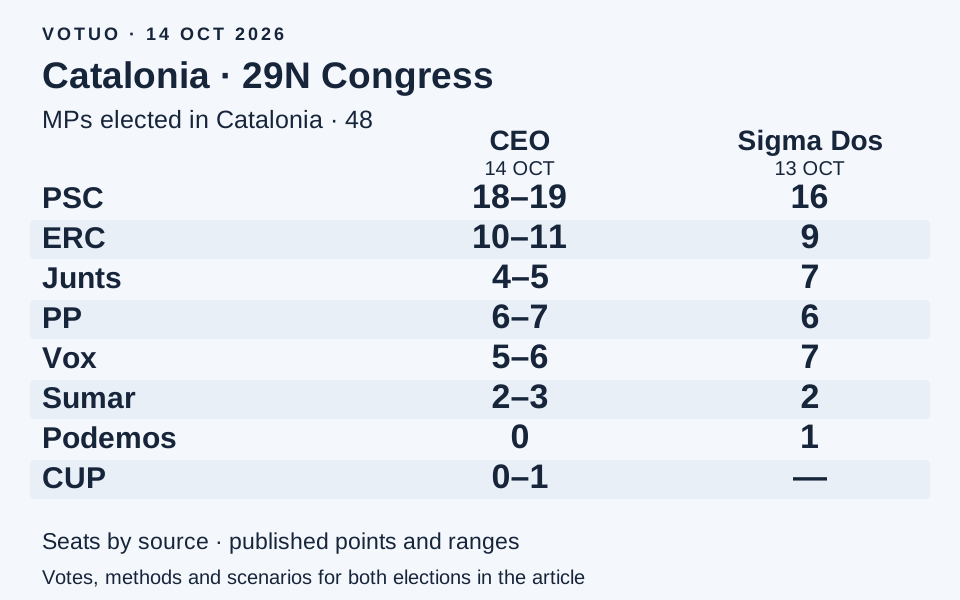
| Party / list | Result 2023 | CEOOctober 14, 2026 | Sigma DosOctober 13, 2026 |
|---|---|---|---|
| PSC | 34.5%19 seats | 29.6%18–19 seats | —16 seats |
| ERC | 13.2%7 seats | 19.0%10–11 seats | —9 seats |
| Junts | 11.2%7 seats | 10.3%4–5 seats | —7 seats |
| PP | 13.4%6 seats | 13.1%6–7 seats | —6 seats |
| Vox | 7.8%2 seats | 12.2%5–6 seats | —7 seats |
| Sumar / Comuns | 14.0%7 seats | 6.0%2–3 seats | —2 seats |
| Podemos | —— seats | 2.5%0 seats | —1 seats |
| CUP | 2.8%0 seats | 2.8%0–1 seats | — |
“—” means unpublished, never zero. Modelled estimates, not raw intention. CEO uses valid votes; Ipsos includes a grouped Other + Blank + Invalid category, which is not renormalised. The CEO report rounds the 2023/2024 baseline figures.
The 2023 Sumar baseline includes Podemos; there is no comparable standalone Podemos baseline. Sigma Dos publishes neither Catalan vote shares nor a CUP row. National figures are not substituted for these omissions.
Votuo analysis
Both sources place PSC first and ERC second. CEO gives PSC 18–19 seats against 19 in 2023; Sigma Dos gives 16. ERC moves from 7 to 10–11 in CEO and 9 in Sigma Dos. This compares with the preceding election, not change between the two institutes.
Vox exceeds its 2 seats from 2023 in both sources: 5–6 in CEO and 7 in Sigma Dos. PP–Vox ordering depends on the study: CEO gives PP 6–7; Sigma Dos gives 6. CEO assigns Junts 4–5 while Sigma Dos retains 7; that disagreement remains visible.
Sumar/Comuns has 2–3 seats in CEO and 2 in Sigma Dos against 7 for the joint 2023 list. Podemos appears separately; there is no separate previous-list comparison and ERC and Podemos are not added to estimate cooperation. Changed candidacies require a new poll.
All poll data
Interviews: September 1, 2026 – October 5, 2026 · n = 2,000 (Catalunya).
Question 45 models separate lists, including CUP and Podemos. CUP subsequently decided not to stand and ERC–Podemos announced cooperation; this estimate does not measure that new scenario. Most interviews precede the election call; fieldwork ends on 5 October.
Shared zero-based scale: 0–40% of votes.
PSC29.6%
CEO published vote interval (95%): 29.0%–31.0%
ERC19.0%
CEO published vote interval (95%): 17.0%–20.0%
PP13.1%
CEO published vote interval (95%): 12.0%–14.0%
Vox12.2%
CEO published vote interval (95%): 11.0%–13.0%
Junts10.3%
CEO published vote interval (95%): 10.0%–12.0%
Sumar / Comuns6.0%
CEO published vote interval (95%): 5.0%–7.0%
CUP2.8%
CEO published vote interval (95%): 2.0%–3.0%
Podemos2.5%
CEO published vote interval (95%): 1.0%–3.0%
2. Catalan Parliament · hypothetical election
29N does not renew the Catalan Parliament. This section asks about a hypothetical Catalan election: 135 seats, 68 for an absolute majority; a simple majority at a second investiture vote. Individual ranges are not a joint distribution or a prediction of agreements.
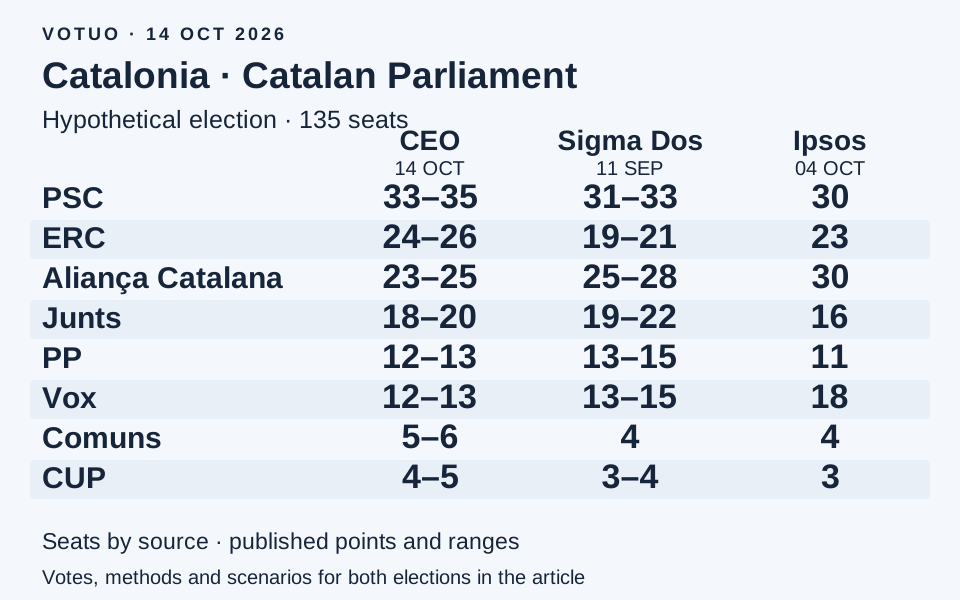
| Party / list | Result 2024 | CEOOctober 14, 2026 | Sigma DosSeptember 11, 2026 | IpsosOctober 4, 2026 |
|---|---|---|---|---|
| PSC | 28.0%42 seats | 21.5%33–35 seats | 23.3%31–33 seats | 21.7%30 seats |
| ERC | 13.7%20 seats | 17.2%24–26 seats | 14.1%19–21 seats | 15.0%23 seats |
| Aliança Catalana | 3.8%2 seats | 15.0%23–25 seats | 16.7%25–28 seats | 17.9%30 seats |
| Junts | 21.6%35 seats | 14.0%18–20 seats | 13.2%19–22 seats | 10.8%16 seats |
| PP | 11.0%15 seats | 9.7%12–13 seats | 10.5%13–15 seats | 8.6%11 seats |
| Vox | 8.0%11 seats | 9.6%12–13 seats | 10.2%13–15 seats | 13.1%18 seats |
| Comuns | 5.8%6 seats | 5.1%5–6 seats | 4.0%4 seats | 4.4%4 seats |
| CUP | 4.1%4 seats | 4.4%4–5 seats | 4.0%3–4 seats | 3.2%3 seats |
“—” means unpublished, never zero. Modelled estimates, not raw intention. CEO uses valid votes; Ipsos includes a grouped Other + Blank + Invalid category, which is not renormalised. The CEO report rounds the 2023/2024 baseline figures.
Votuo analysis
In CEO and Sigma Dos, PSC remains first by vote share, below its 28.0% in 2024: 21.5% in CEO and 23.3% in Sigma Dos. Junts is also below its previous 21.6%. ERC exceeds its 2024 share of 13.7% in both estimates: 17.2% and 14.1%.
Aliança Catalana rises from 3.8% and 2 seats in 2024 to 15.0% and 23–25 in CEO, and 16.7% and 25–28 in Sigma Dos. CEO places ERC ahead of Aliança; Sigma Dos reverses the order. Fieldwork overlaps in September, so the difference is not treated as October growth or decline.
PP is below its 2024 share of 11.0% and Vox above 8.0% in both sources. Comuns is below its previous 5.8%; CUP is near its 4.1%, estimated at 4.4% and 4.0%. Such small differences do not establish a precise trend without uncertainty assessment.
Ipsos adds a material disagreement: PSC remains first by votes (21.7%) but ties Aliança (17.9%) at 30 seats each. ERC has 15.0% and 23 seats; Vox 13.1% and 18. Junts has 10.8% and 16; PP 8.6% and 11; Comuns 4.4% and 4; CUP 3.2% and 3. The model also publishes Podemos (2.1%) and Other + Blank + Invalid (3.2%). These methodological differences are not treated as change over time.
All poll data
Interviews: September 1, 2026 – October 5, 2026 · n = 2,000 (Catalunya).
Question 39 concerns a hypothetical Catalan Parliament election, not the 29N vote. CEO publishes no complete central 135-seat allocation. Ranges are not converted to midpoints.
Shared zero-based scale: 0–40% of votes.
PSC21.5%
CEO published vote interval (95%): 20.0%–23.0%
ERC17.2%
CEO published vote interval (95%): 16.0%–18.0%
Aliança Catalana15.0%
CEO published vote interval (95%): 14.0%–16.0%
Junts14.0%
CEO published vote interval (95%): 13.0%–15.0%
PP9.7%
CEO published vote interval (95%): 9.0%–10.0%
Vox9.6%
CEO published vote interval (95%): 9.0%–10.0%
Comuns5.1%
CEO published vote interval (95%): 4.0%–6.0%
CUP4.4%
CEO published vote interval (95%): 4.0%–6.0%
What support would need negotiation
CEO and Sigma Dos publish no complete central Catalan Parliament allocation; their ranges are not turned into midpoints. Ipsos publishes 135 central seats, used separately below. The ceilings below only rule out an absolute majority within the published party ranges: they are not coalition intervals or probabilities. Being below 68 does not exclude a second investiture with abstentions.
| Hypothetical support | CEO | Sigma Dos |
|---|---|---|
| PSC + ERC + Comuns | 67 / 135 | 58 / 135 |
| PSC + Junts | 55 / 135 | 55 / 135 |
| ERC + Junts + CUP | 51 / 135 | 47 / 135 |
The PSC–ERC–Comuns combination that held 68 seats in 2024 would need other votes or abstentions in these scenarios. ERC–Junts–CUP is also insufficient alone within the ranges. Adding Aliança changes pro-independence arithmetic, but a shared territorial goal does not establish compatibility on migration, public services or economic policy. Cross-party cooperation also requires explicit agreements; polls do not establish them.
Catalan Parliament investiture rules ↗Scenarios using Ipsos’s 135 seats
Central allocation published 4 October, not an election result. These combinations are hypothetical sums, not confirmation of agreements, political compatibility or support for a candidate. Pro-independence and right-wing groupings in particular include parties with substantial differences.
| Hypothetical combination | Estimated seats | 68-seat threshold |
|---|---|---|
| PSC + ERC + Comuns | 57 / 135 | Below |
| PSC + ERC + Junts | 69 / 135 | Meets |
| ERC + Junts + CUP + Aliança Catalana | 72 / 135 | Meets |
| Junts + PP + Vox + Aliança Catalana | 75 / 135 | Meets |
| Vox + Aliança Catalana | 48 / 135 | Below |
Explore an investiture vote · Ipsos
For: 57 · Against: 78 · Abstain: 0
First vote (68): Below the threshold
Second vote (for > against): Below the threshold
What might change in public policy
Interpretation conditional on agreements, legislation and resources. Cited documents are precedents or reviewed positions, not complete and final 29N manifestos.
Housing: budgets and regulation
Continued PSC, ERC and Comuns cooperation has a precedent in the 2024 investiture agreement: protected housing and seasonal rental regulation. A narrower parliamentary base would require negotiating funding, deadlines and support for each measure. Junts proposes mortgage/rent deductions in Congress; PP proposes first-home tax relief. A different majority could change this mix, without automatically ensuring lower rents or more supply.
Funding and public services
ERC presents the January 2026 funding agreement as a route to more resources and fiscal autonomy. More seats could strengthen its negotiating position if its votes were needed; they do not prove full implementation. State legislation and budgets need support in Madrid, while the Catalan Parliament decides devolved spending. Catalonia’s 48 Congress seats cannot determine that outcome alone.
Migration: votes and responsibilities
Vox’s growth in both contests and Aliança’s in the Catalan Parliament could increase attention to migration without making them allies. Vox opposes extraordinary regularisation and PSOE supports it. Changing it requires state decisions; reception and public-service effects in Catalonia also depend on budgets and administration. Aliança is not assigned Vox’s programme and vote shares do not establish a specific measure.
Methodology and sources
Selection: the latest verifiable primary results published for each institute and contest from 1 September to 14 October. A documented comparison, not an exhaustive census. The September Catalan Parliament poll is explicitly dated, not presented as a new October poll. No house adjustments or filling missing percentages.
CEO · Congress · October 14, 2026
- Commissioner / fieldwork provider
- Centre d’Estudis d’Opinió · Generalitat de Catalunya / GESOP
- Interviews
- September 1, 2026 – October 5, 2026 · Presencial / face-to-face
- Completed interviews
- n = 2,000 · Catalunya.
- Population
- Spanish citizens aged 18+ living in Catalonia and eligible to vote.
- Sampling and weighting
- 236 census sections in six strata defined by electoral similarity; selection proportional to the electorate, random routes and sex, age and birthplace quotas. Replacement sections account for 21% of interviews.
- Reported uncertainty
- CEO approximates sampling error at ±2.19 points at 95% confidence and maximum variance. Party vote and seat intervals are reproduced as CEO labels them (95%); they are not agreement probabilities or a measure of all model uncertainty.
- Methodology
- Census-total equivalence: recalled-vote/intention matrix, turnout adjustment, exclusion of undecided respondents, recalled-vote weighting and provincial seat allocation assuming a distribution similar to the preceding election (report p. 5).
- Limitations and context
- Question 45 models separate lists, including CUP and Podemos. CUP subsequently decided not to stand and ERC–Podemos announced cooperation; this estimate does not measure that new scenario. Most interviews precede the election call; fieldwork ends on 5 October.
Sigma Dos · Congress · October 13, 2026
- Commissioner / fieldwork provider
- El Mundo / Sigma Dos
- Interviews
- October 1, 2026 – October 8, 2026 · CATI / CAWI
- Completed interviews
- n = 2,017 · España. Catalan sample: unpublished. National sampling error is not applied to Catalonia.
- Population
- Residents aged 18+ eligible to vote in the study territory.
- Sampling and weighting
- Telephone: random household selection and sex/age quotas. Panel: allocation by sex and age. The reviewed source does not publish the full questionnaire or individual weights.
- Reported uncertainty
- ±2.2 points at 95.5% confidence and maximum variance applies nationally, not to Catalonia. The reviewed sheet does not publish the Catalan subsample size or error.
- Methodology
- Institute-published projection. The reviewed sheet does not specify the turnout model or provincial vote-to-seat conversion.
- Limitations and context
- Territorial breakdown of the same national study, not a separate Catalan poll. Publishes 48 Catalan seats but no Catalan vote shares. Fieldwork predates announced ERC–Podemos cooperation; their electorates are not added together.
Full questionnaire not located in the reviewed primary publication.
CEO · Parlament · October 14, 2026
- Commissioner / fieldwork provider
- Centre d’Estudis d’Opinió · Generalitat de Catalunya / GESOP
- Interviews
- September 1, 2026 – October 5, 2026 · Presencial / face-to-face
- Completed interviews
- n = 2,000 · Catalunya.
- Population
- Spanish citizens aged 18+ living in Catalonia and eligible to vote.
- Sampling and weighting
- 236 census sections in six strata defined by electoral similarity; selection proportional to the electorate, random routes and sex, age and birthplace quotas. Replacement sections account for 21% of interviews.
- Reported uncertainty
- CEO approximates sampling error at ±2.19 points at 95% confidence and maximum variance. Party vote and seat intervals are reproduced as CEO labels them (95%); they are not agreement probabilities or a measure of all model uncertainty.
- Methodology
- Census-total equivalence: recalled-vote/intention matrix, turnout adjustment, exclusion of undecided respondents, recalled-vote weighting and provincial seat allocation assuming a distribution similar to the preceding election (report p. 5).
- Limitations and context
- Question 39 concerns a hypothetical Catalan Parliament election, not the 29N vote. CEO publishes no complete central 135-seat allocation. Ranges are not converted to midpoints.
Sigma Dos · Parlament · September 11, 2026
- Commissioner / fieldwork provider
- El Mundo / Sigma Dos
- Interviews
- September 1, 2026 – September 9, 2026 · CATI / CAWI
- Completed interviews
- n = 2,231 · Catalunya.
- Population
- Residents aged 18+ eligible to vote in the study territory.
- Sampling and weighting
- Telephone: random household selection and sex/age quotas. Panel: allocation by sex and age. The reviewed source does not publish the full questionnaire or individual weights.
- Reported uncertainty
- Sheet reports ±2.1 points at 95.5% confidence and maximum variance. This does not cover all panel or projection uncertainty; seat-range probability coverage is not specified.
- Methodology
- Institute-published projection. The reviewed sheet does not specify the turnout model or provincial vote-to-seat conversion.
- Limitations and context
- Catalan September study, not an October poll, stratified by province and habitat. CEO has longer, overlapping fieldwork; differences between institutes do not establish change over time. Comuns publishes 4 seats; there is no complete central allocation.
Full questionnaire not located in the reviewed primary publication.
Ipsos · Parlament · October 4, 2026
- Commissioner / fieldwork provider
- La Vanguardia / Ipsos Iberia
- Interviews
- September 23, 2026 – October 1, 2026 · CAWI (1.500) / CATI (500)
- Completed interviews
- n = 2,000 · Catalunya.
- Population
- Catalan residents aged 18+ eligible to vote in regional elections.
- Sampling and weighting
- Province, municipality size, sex and age quotas. 1,500 online and 500 telephone interviews, 92% mobile; demographic and recalled-vote weighting. Panel recruitment and individual weights are not detailed.
- Reported uncertainty
- Sheet reports ±2.19 points at 95.5% confidence, maximum variance and 95% post-weighting efficiency. This is a study-level figure, not an interval for each modelled estimate or a majority probability.
- Methodology
- Census-total vote transfers, individual allocation of undecided respondents and weighting by municipality size, sex, age and recalled vote. Estimated turnout: 57% of the resident electorate (p. 39).
- Limitations and context
- Report prepared 2 October and published by La Vanguardia on 4 October. The table groups Other + Blank + Invalid: its basis is retained, not renormalised as strictly valid votes. The sheet refers to Spain and general elections despite regional coverage, questions and projections; this documentation inconsistency is disclosed.
Full questionnaire not located in the reviewed primary publication.
Data reviewed: · ESOMAR/WAPOR · AAPOR
Download data (CSV) ↓How to read this update
Published estimates are compared with their limitations documented. Support sums are arithmetic scenarios, not evidence of a political agreement or future majority.
Original source
Official source · CEO · Sigma Dos / El Mundo · Ipsos / La Vanguardia ↗
View the event chronology →